Statement by Alma Hilton Marsells
Our Familv Treasure
This is dedicated to the memory of my beloved husband, William Bernard Marsells, born April 22, 1927 and died February 19, 1991. Bill was such an important part of my life! I cannot imagine what my life would have been without him. Without him, our children and grandchildren would have been non-existent. Bill had a zest for life, but was the most caring person for anyone close to him.
About 1943, our paths first crossed. We were all working at Mars, Inc. (the candy company). There were many teenagers working there during World War II; but there was a small group that developed very close friendships - this consisted of approximately 6 girls and 9 boys – there was no “pairing off”. Almost every weekend, our gang would plan fun events. Most of the time we went to the beach in the summer and Bill would bring his “medicine ball” (which, as I remember, was a full 3’ in diameter when it was blown up - it was like a large beach ball with a tough cover). The girls would bring a picnic lunch, and the boys would bring the soda or Kool Aid, and the air pump. While the girls set up the food, the fellows would blow up the medicine ball; then we would play either Dodge Ball or Keep Away - we had so much fun! For a change, we would sometimes go to a forest preserve for a picnic and a game of softball, or spend the day at the swimming pool at Riis Park in Chicago. We would pick a meeting place, and take the streetcar or bus (sometimes both) to wherever we had decided to go for the day. When it was time to go home, we each went our own way. In the wintertime, it was ice-skating, tobogganing and snowball fights (that ended up with a lot of “face washing”).
Bill’s friends were so important to him. He was always with the boys. His boyfriends were all interested in girls long before Bill took an interest. Dating girls came about as a necessity so that he could be with his friends. In 1946 they took the stand that if he wanted to continue to go places with them, he had to find a girl as they were taking their girlfriends with them. I used to feel sorry for any girl that would date Bill as he would get on the streetcar or bus, and very seldom check to see that they got on. When Doris Drury asked him to take her to the Trinity High School prom, would you believe, he rented the tux, but loaded his chest down with Ben Gay. She didn’t dance too much with Bill, as every time they tried dancing, the odor would really get to her. Through the years, Bill often laughed reminiscing about that night. In his mind, girls weren’t for him to date - they were to provide him a chance to be with his friends.
Deen and Bill were in the same Army Air Force unit stationed at Chanute Field. (Deen Holland and Bill were lifelong friends - went into the Army at different times, and Deen was later transferred to the base where Bill was stationed and was under him.) On the 25th, on the train going to Chicago, Bill had asked Deen as to what could they do for the weekend? Deen replied that he was going to spend the time with his steady girlfriend, Mary (not the Mary he married), so that the only way Bill could be with them was if he had a date too. When Bill said he didn’t know of any girl that he would want to ask on a date, Deen suggested that he call me. That sounded okay to Bill, as I was not a girl, in his mind, I was one of the “gang”. When he called, it just so happened that my date had become sick so I had the night free. Remembering the good times we had had with our gang, we had our first date, May 26, 1946. Needless to say, we had such a good time, that every weekend thereafter we were together, and one month later, June 26th, we were going steady and wearing each other’s high school graduation rings. November 23, 1949 we were married.
During the period we were dating, I woke up one morning with a “full-blown” case of German measles (my 4th case). Bill came by the house with my first bouquet of flowers: a dozen gladiolas with a card addressed to “My Polka Dot Queen”. I faintly remember the card had a picture of a girl sitting in bed, and he had covered the face with red dots.
Bill was very close to his parents - but especially his mother. From 1945 through June 10th, 1948, when she died, she fought a desperate battle with cancer. She was only about 5’ and weighed about 200 lbs. before the cancer was discovered. When she died she didn’t even weigh 50 lbs. When Bill got out of the service, he gave his Dad his severance pay; along with all the money he had saved to put towards the mountain of bills his mother’s illness had created. Times were very different at that time- individual hospitalization was not available as it is today, and Bill’s Dad, even though he was earning a very good wage, was drowning in debt from the medical bills. Bill had not loaned the money to Dad, it was a gift that he did not expect to get back. (That is the kind of guy that Bill was.)
During the days of World War II, many boys dropped out of high school to enlist in the military service, to do their part in “fighting to defend our freedom” - Bill was one of those fellows. He had been going to school at Fenwick High School in Oak Park (a private Catholic college preparatory school) and had had all intentions of going on to college when he graduated from high school. Fenwick changed their policies, and arranged for these “drop outs”, while they were in the service, to complete their high school credits through correspondence. Bill completed his requirements and received his high school diploma through the mail.
When Bill was discharged from the Air Corps, he enrolled at the University of Illinois, planning to get his college degree. But, that was one dream that he was not to realize. Bill’s mother’s health was really deteriorating, and when his Dad could not find anyone to care for Bill’s Mom while Dad was at work, Bill dropped out of college and chose to stay home to care for his mother. It was 2 years that Bill devoted to his mother and was proud that he was able to do that for his parents. Bill was always squeamish at the sight of blood, yet God gave him the strength and will power to care for his mother in a manner that he himself never believed that he could. (For many years, after his mother’s death, Bill would wake up from a deep sleep, in the middle of night, thinking he heard his mother calling to him for help - for the 1st year of our married life, it was every night.)
Bill’s mother was the instigator for our being married. Bill and I had broken up 3 different times because of our religious background. As she was a very strict Polish, Roman Catholic, it surprised Bill, when she always tried to get us back together. It was her fervent desire that we would get married. Her biggest dream was that one day she would get well, and we would be married, and that she would be there to celebrate our wedding. She often told us that she wanted to see us married, and that she wanted us to have a granddaughter for her to play hopscotch or jump rope with. (That is why, when each one of our daughters was born, Bill always looked at me with tears in his eyes and say, “Mom, would have been so very happy!”) It was that deep desire that she had, that caused Bill to play his biggest prank on me.
My mother had always been very strict with me. Bill and I were going steady, and mother was not very happy about it. To date Bill, I was really defying Mom. At the time she had not gotten to know Bill - all she knew was that he was Catholic, and that was a big no, no . Mother had a very strict code of ethics of how a girl should act, types of gifts that were acceptable (never anything very personal) and what types of people were dating or marriage material (1st and 2nd generation foreign-born were okay people to talk to or be friendly to, but a different “class” for a daughter to marry).
As Bill and I had finally reached the point where we had decided that we each wanted to spend the rest of our lives together, Bill told me he was going to get me a negligee gown and robe for Christmas; what color would I like? I was horrified, how could I face Mom? I’d probably be thrown out on the street. The more I worried about it, the more Bill talked about the gift. He decided it had to be a black one. For several weeks, that was all I heard. No matter how hard I tried, I could not get Bill to give up this notion.
Christmas Eve came and I was over at the Marsells’ home. Dad and Ron were sitting in separate chairs across the room, and Bill was sitting by his Mom. She was stretched out on the couch in a makeshift bed, and the presents were passed out. She had wanted me to sit near her so that she could watch me open my gifts. I sat on the floor by her, hoping against hope that Bill did not get me the dreaded gift. That awful moment came, and Bill’s mother passed down the box - it was a dress box. I wanted the floor to open up and swallow me. There was Ron, Bill, his Dad and Mom, all watching me - I put off opening the box as long as I could -all other gifts had been opened, and I’m still sitting there with the wrapped dress box. Try as I could, I could not find a way to escape this moment. Bill’s Mom was badgering me to open the box. I handled the box as though it contained a sensitive bomb that would explode at any moment. I gritted my teeth and proceeded to unwrap it. There, the paper was off - I shook the box for any noise, hoping there would be one, and then I could open the box knowing it was not that dreaded negligee. The box lid is off, but there’s the tissue with a seal holding it shut. Bill’s Mom is anxious and saying, “Bunny, don’t be so slow, I want to see what Billy got you”. What will their thoughts be when I reveal the dreaded negligee? But, wait, the tissue is laying funny. I touched the paper near the corner of the box, and there didn’t seem to be anything under it - yet the center still stayed as high as it was when I removed the lid. Could it be possible that it was something else?
Now, it didn’t seem to be so bad to remove the tissue. There in the center of the dress box, was another gift that was taped there. It was much smaller - what could it be? I excitedly picked up that package and unwrapped it -it’s a ring box! There, inside was a special engagement ring. It was so very special as Bill had given all his money to his Dad, and then got a job at St. Celestine’s school (across the street from his home) as an assistant janitor and he had been working nights after his Dad got home, in order to earn money to buy me this ring. His mother was so proud! Bill’s eyes were brimming with tears of pride and happiness. I will always cherish that moment. No engagement ring ever had the love and effort put into it as that one did.
It was not a very romantic way to receive an engagement ring, but both Bill and I shed many tears of joy knowing how happy it had made Bill’s mother to share that moment with us. We (Bill and I) both knew that his mother would not be able to live to see us married and to see us engaged and planning our marriage, was the next best thing for her. Bill’s Dad was overjoyed at seeing how happy Bill’s mother was - it was a very bright silvery lining in a dark gloomy cloud that hung over their lives for almost 3 years.
Bill’s whole life centered on his family, caring and providing for them. His happiness depended so completely on seeing that everyone else was happy. He had immense pride in his loved ones and doing everything possible for them. He treasured every one of his family members; but, in reality, he, was the treasure of our family!
Alma Hilton Marsells, February 14, 2005
Statement by Alma Hilton Marsells
Entering The Work Force
My working career started in May 1943, I had just turned 16 and immediately went to my high school counselor and got my working permit. I applied at a few different places, Alden’s (a competitor of Sears) hired me and I was so excited - I was hired as a clerk and would be earning 12 ½ cents an hour (Wow!). Alden’s was located on Grand Avenue, just a block west of Harlem Avenue, on the north side of the street - where Goldblatt’s eventually took over. Would you believe, I was there only 2 days when Montgomery Ward’s called and asked me to work there. I was so excited that I told Alden’s I was quitting- after all, Montgomery Wards offered to double my wages - I would be earning 25 cents an hour. (Ward’s was located on Grand Avenue, exactly across the street from Alden’s) Yippee!
Life at Montgomery Ward’s was not so glamorous! The first week they had me dusting, cleaning, and watering their house plants. They had live houseplants in the middle of the store. The plants were in individual pots, but they must have been planted in “pop-up” soil, as there was more dirt and mud outside and around the plants than there was inside the pots. The dirt must have been a good inch deep around the base of all the pots. - Yuck! They did not give me any tools to work with; so I improvised with cardboard, etc. Naturally I fell back on Mother Nature’s gifts to me, my fingernails. I would spend hours at night soaking and cleaning my hands, and repairing my broken and dirty nails. I was very unhappy; but the worst was yet to come!!!!!!!!!!
The second week, they had me cleaning all the toilets on display in the back of the store. The 4 department managers had their card table set up in the back, and they played cards there so they could supervise me as I worked.. That job was not an ego builder!!! One day, as I was hard at work, with my head in one of the display toilets, a group of high school fellows wandered into the store. I spotted them first; I wanted to hide, but, I was too big to climb into one of their toilets to hide. Much as I tried to stay undercover, one of the fellows spotted me and they came back to tease me. Horrors! I was never so embarrassed! One of the card shark managers reminded me I was being paid to work, not to socialize. I wanted to reply, “Are you being paid to play cards, but I was too shy to do anything, but slink back into my beloved(?) toilets. No shock to anyone, I’m sure, that was the end of my job at “Monkey” Wards, no longer was I going to subject myself to such humiliation! But, it was months of living down the teasing that I got from my high school chums - or should I say chumps?
Luckily, when I got home that night, Mom informed me that Mars, Incorporated had called and wanted me to return the call. As I had no intention of having anything to do with Wards, the next day, after school, I stopped in at Mars to see Mr. Smithers, the Employment Manager. He asked me if l would like to work there - are you kidding? Mars was just½ block east of my home. They are located at 2019 North Oak Park Ave. in Chicago. The distance from Oak Park Avenue to their employee entrance, was probably further than from Mom and Dad’s home to Oak Park Avenue. And, believe it or not, I would start out at 37 ½ cents an hour. My pockets would soon be lined with gold! Ha!
It was considered a privilege to work at Mars. Frank and Ethyl Mars started making candy for their own use when they lived in the Twin Cities area in Minnesota. So many people started requesting their candy, that they started making candy to sell as a business. They used their kitchen as the base of their operation. It was not too long before they needed more room, and their garage was converted into a small factory. They had grown and now had 7 employees. They were booming! Transportation costs were becoming exorbitant, and they again needed more room. To move their plant to Chicago, seemed to be advisable as Chicago was considered the hub of transportation. There had been a golf course in that location, but now was being developed into homesites.
Frank Mars purchased land in the Galewood section of Chicago. When word got out that Frank Mars was contemplating building his manufacturing plant there in a residential section; the news was not well received.
Frank had several meetings trying to pacify the residents. He assured them that if they would let him build his plant in their neighborhood, they would never regret it. That instead of lowering the value of their homes, it would have a reverse effect and would be an asset to the neighborhood. He lived up to his promise. In the 40’s and 50’s he had a crew of 15 gardeners. As Mars has their own well, they are able to water their lawn, no matter how dry weather conditions are; they have automatic in-ground sprinklers. Every morning, in nice weather, you can see gardeners out with bamboo poles, knocking the dew off the blades of grass. There is a constant showing of flowers: tulips in the spring, canna lilies in the summer, and chrysanthemums in the fall. In the winter, the evergreens receive their daily shaking of branches to keep the weight of snow from breaking their branches. The plant is always decorated during the holidays.
Employees are banned from parking on the residential streets as ample parking is available in back of the plant. Residents are encouraged to call the Personnel Office in case of any problems. Employees violating any of the good-neighbor agreements are immediately reprimanded. Spur railroad tracks adjoin the Mars plant, and the Milwaukee Railway System has a passenger train stop just north of the Mars plant. This station is named Mars after Frank Mars and his plant. Many of the raw materials are delivered to the Mars plant and switched onto the spur lines.
Employees inside the plant are required to wear both hairnets and hats. Clean uniforms are supplied every day. If, during working hours, an employee has a soiled uniform, they are excused to go to the dressing room to change into a fresh uniform. No jewelry can be worn in the plant. For cases where females refused to remove their wedding bands, they had to report to the nurse’s station before work to have a finger bandage placed over their ring finger; the bandage has two ends that was then tied around their wrist. This was then coated with a waterproof substance. They were forbidden to leave the premises until they had reported back to the Nurse’s station to have the bandage removed. Most women eventually broke down and removed their wedding bands when working..Safety pins were also a forbidden item to be worn. At times, “spies” were in the dressing room, watching for signs of clothing that had been pinned. In such cases, the employee could not work until a pin had been replaced by use of a needle and thread, and time was docked from their work hours.
During the Depression years, Mars’ management prided themselves on never laying off any employee. Instead, they cut back the hours, when necessary for economic reasons, for every employee. Husband and wife teams were not allowed to work. Frank felt that as long as each family had one member with a job, none of the Mars’ families would be without money for food and clothing. They had employees that “spied” on suspected married couples. If a couple were engaged and it was discovered that they ended up, after hours, at the same house, then an investigation was done to see if they were secretly married. If this was proven, then one of the married partners had to quit their job at Mars. Frank always felt by having the quality candy bars selling for 5 cents, that parents always found a way of treating their kids with something to satisfy their “sweet tooth”.
Candy bars were made Monday thru Friday. When we “high schoolers” worked there, everyone was required to work 6 hours on Saturdays just to “clean up”. We’d report to work in our clean uniforms, and we were given a metal tool that was close to 6” long x ½” wide and possibly 1/8” thick. This was used to clean any hunks of candy from the conveyor tracks. Candy droppings were placed into boxes and were disposed of by burning.
We were given a break after 3 hours of cleaning. Peanut butter and cracker sandwiches and fresh doughnuts were served, along with milk, coffee or tea. The peanut butter was fresh, and was made in their kitchen and the doughnuts were also made in their kitchen. After another 3 hours of work, we were able to go home for the weekend. After we left, their cleaning crew, dressed in special suits, gloves, helmets and boots, moved in with their steam hoses and cleaned down every inch of the inside of the plant. Mars had, and I think still has, the reputation of being the cleanest plant in the Chicagoland area.
Mars, Inc. was always considered an ideal place to work; as a result, it was a difficult place to be hired at. Top priority was given to local residents. Frank Mars felt that a local resident would be more desirable and dependable as there would be no lengthy traveling time going to and from work. As a result, a person who valued having less traveling time and more time at home with his family, would be a more dependable employee. After the depression, having a relative as a Mars’ employee would give an ‘inside-track’’ for being hired. Frank felt that if an employee had proven to be a dependable and loyal worker, then, in all likelihood, his relatives would probably have the same traits.
Every year, during the plant shut-down, every one of the plant employees received a vacation with pay. Then an even more thorough cleaning was done throughout the whole building, and any painting or decorating was also done at this time.. Office employees were not restricted to taking their vacation during plant shut-down. The office employees did not have as generous a pay scale as the plant employees, but there were other benefits.
Office employees received 2 shopping days with pay, a more liberal vacation schedule, a Christmas bonus; and, all office positions were salaried. Every Friday was payday and Brinks would come to the plant to cash checks for each shift. Candy bars, considered “seconds” were offered to the employees for 30 cents for a box of 24 candy bars. They also offered a pension plan that employees could pay into. At Christmas time, Chocolate·butter creams were specially made for Christmas. A 2-lb. box of private brand chocolates was given to each of their prized customers and to each of the office employees.
Mars staffed the cafeteria with their own employees. A delicious hot meal, with beverage and desserts were offered to any employee for much less than $1 each. An individual menu was printed each day for the Management. They would place their order around 11 AM, so that when they went to lunch, there was no long waiting period for preparation of their food. Their meals were served in the private dining room where they alone ate. These meals were considered a”fringe benefit” for the Management. Their dining room was decorated in an English setting, walnut paneled walls, custom-made long walnut table with matching captain-chairs with leather backs and seats, and paintings hung on the walls that displayed English fox-hunt scenes. About 1946, the procedure was that the Brinks employees would come inside of the plant to the lunchroom, with their bags of money. Then in the back of the lunchroom, they would sit at a counter made up of 2 long lunch tables. The cash boxes were on the table, and employees would come on their break, form a line, and file by the Brink’s employees and the Mars’ employees would then get their checks cashed. We had an incident about 1946, that changed this procedure: an employee from the 3rd shift, had been in “cahoots” with 2 ex-cons to hold up the payroll while the Brinks employees were sitting in the open lunchroom. Luckily, one of these 3 had done too much talking, and a stool pigeon or an informant that had known about the proposed plans “snitched” to the authorities. The night of the planned hold-up, local police, and FBI, were in wait. The 3-hold-up fellows had been armed- at least one had had a sub-machine gun, but the FBI was able to take them before they got inside the Mars’ plant. Luckily, no shots were fired, thus no one was injured. Thereafter, the Brink’s employees remained in their truck inside the closed gates of the Mars’ parking lot and the Mars’s employees had to file past the truck to cash their checks.
Frank Mars was a humble man, compassionate and respectful to any person in any walk of life. Ethyl, his second wife, was just the same. They were as loyal to their employees as they expected their employees be to them. The employees they had in Minnesota, were offered life-time jobs with Mars if they would re-locate with them in the Chicago area. Their favorite jockeys from the Milky Way Farms in Tennessee were given life-time jobs in Mars, when they were no longer able to ride. Ethyl’s traveling secretary (Dorothy Swanson Becker) ended up as Assistant Traffic Manager in Mars when Ethyl’s health prevented her from traveling.
Statement by Richard Allen Hilton
January 9, 2005
To my Sister Alma, my daughters Sandy Ryan, Kristie Hilton and Jenny Hilton, Grandchildren Alyssa Tyson, Ross Weter and Blake Tyson and my Son-in-law James Ryan
Forward
When I began reading A Christmas Story by Jean Shepherd, a book given to me by my Granddaughter Alyssa for Christmas 2004 I started recalling events of my own childhood. This “recall” prompted me to begin an accounting of some of the experiences that help to explain how I came to be who I am. Some of my experiences may have been embellished in my memory of how things happened and others may be missing what to others could be important details. Still others are in the recesses of my memory waiting to emerge at some later time. Nevertheless, what follows is a sketch, based on my sometimes limited recall of what it was like, growing up in the Chicago area with my Mother, Father and sister Alma as my guide.
Thank you Alyssa.
Humphrey Ave., Oak Park, IL
I was born to Effie Malinda (Sims) Hilton and Almer Eric Hilton at West Suburban Hospital, Oak Park, Il., on August 25, 1936. At the time, we all lived in an apartment building on 7 West Thomas Street in Oak Park, Il._
My earliest recollections of the first 4 ½ years of my childhood are limited by the expanse of time between these experiences and the number of years that have followed. My Mother often bragged of my being potty trained by the age of 6 months. My wife Nancy thinks it was the other way around since I am such a “regular” guy.
I can recall the name of Mr. & Mrs. Picell, an older couple that lived next door, to the north, 743 North Humphrey, in what I remember as a frame home with a closed-in porch. The house was painted a light green and the door was on the side of the house. When we would go back to visit after moving into the house where I “grew up”, they would always have their green & white 1939 Plymouth in their garage where it stayed when Mr. Picell wasn’t driving it. The last time I recall seeing that car (it was several years after we had moved away) it was in their garage and still in mint condition.
A couple of doors to the south is where the Giuffie[1] family lived. To the best that I can recall they had 2 boys and 3 girls, all much older than me. Their youngest son, Joey, was one of my constant playmates.
Our landlady, Mrs. Goolman had 2 boys and 1 daughter, all much older than me. One of her boys, Donald,was killed in a battle for control of an island in the Pacific Ocean during World War II. I don’t know what year it was but I can remember my Mother on the phone with Mrs.
Goolman for what seemed like a very long time, occasionally wiping a tear and talking very softly. Often when stressed, my Mother would rub her palm with the last 3 fingers of her hand while pressing her index finger around the tip of her thumb. By the time she finished talking to Mrs. Goolman she had developed a huge blister on the palm of her hand.
We lived with Mrs. Goolman during this time. As I recall, our “apartment” was on the 2nd floor of their home. Our family consisted of my Mother & Father, my sister Alma, and me. Other than the faint recollections of the neighbors, I best remember the furnace that heated their home. It was coal fired and had large circular vents that ran upwards and at angles from the furnace to the basement ceiling and supplied all the heat to the upstairs rooms. To this day, that kind of furnace system is commonly referred to as an old octopus.
Often, my Mother would allow me to entertain myself, sometimes while she would visit with Mrs. Geoffiey[2]. During one of these opportunities to “entertain”, I discovered the neat sounds that would result from dropping metal items through the grate that covered the heat vent in the floor. I think that the first item I ever dropped down the grate was a penny. The item bounced along the vent, making small clanking sounds until finally landing in the firebox of the furnace. On succeeding occasions, I would spirit spoons from mom’s silverware drawer in our apartment and while she was not paying attention to my activities, I would drop spoons down the grate and listen to them bounce along into the firebox. At some point mom noticed the disappearance of her spoons and began what became over the years, a systematic investigation of my activities and behaviors. I don’t remember the specific punishment but I suspect that I received a well-earned spanking.
At the end of the block south of where we were living was a neighborhood grocery store owned and operated by a family who maintained the store on the first floor and lived upstairs.
These stores are referred to in the business community, as mom and pop operations and today, are almost extinct. When we moved to our home on Dickens Avenue there was another such store in that neighborhood and I will fill you in with a couple of my experiences with that one later. I can vaguely remember going to this store on occasion with my mother or sister and being treated with penny candy. I think my favorite was candy that came as tiny dots stuck on a strip of paper, 4 or 5 dots in a row, row after row after row. I would wrap the paper around my index finger so that the row of candy dots would stand out and peel them off with my front teeth. Yummy!!!
Another recollection is of Charles Schwem (sp). Charles was a couple of years older than me. The Schwems’ also lived in Oak Park but in a big house on Ridgeland Avenue. Mrs. Schwem and Mom would get together occasionally to visit and Charles and I would play. There’s a picture of me standing on the back platform of his pedal-powered fire truck. We didn’t know each other real well but from what I can remember, we did seem to get along.
6824 W. Dickens Ave., Chicago
I think that it was early in 1941 when we moved into a new home on the northwest side of Chicago. It was in the neighborhood called Montclare. Dad and mom had the house built and Mother never wanted to leave or sell it. To her it was our “home” and as the years went by she would not entertain any thought of moving from it. It is a 2-story house with a full basement.
The house is constructed of “Chicago” common brick and has a bay window that looks out onto Dickens Avenue. It was the only of that style in the immediate neighborhood. After we had lived there for a while Dad built a garage on the back of our lot that matched the architecture of the house. Many years later Dennis Toren and I wrapped the garage in aluminum siding. At the time built, the total cost of the house was approximately $5,200. It had 2 bedrooms, living and dining rooms, a kitchen and bath on the first floor. The attic and basement were unfinished.
Between the living and dining rooms were enclosed stairways to the basement and attic. Soon after moving in Dad finished off the front half of the attic as a bedroom for me.
At the top of the stairs going to my room was a large open area where I had my dresser. There were also 2 closets for clothes. Further on towards the front wall of the house a single bed was built into each side of an interior wall. I slept in one bed and my Grandmother Hilton or Grandmother Sims would sleep in the other when they came to visit and stay with us. This is also where my Aunt Teresa slept while my Uncle Clyde (Mom’s brother) was finishing out his rehab at Great Lakes Naval Training Center in North Chicago from injuries received while serving in the Marine Corps during World War II. Dad also provided me with a “secret” hiding place in my room. He built a bookcase into the front wall of my room, opposite the built in beds. Behind the bookcase was a space about 2 feet wide and 3 feet high and about 6 feet deep that was created when he constructed the inside wall of my room. The bookcase was hinged so that I could swing it open and “hide” things behind it. In the basement Dad built a workshop area for himself that included a built-in radio and a whole bunch of drawers and doors in, under, and around his workbench. Most of the material used to build the cabinets came from crates he would bring home from the rail yard where he worked. He would knock them apart and pull the nails, measure, cut the wood with a handsaw [he had one saw to cut with the grain (rip saw) and another to cut against (crosscut) and re nail the pieces in place. My job was to take each nail that he had pulled from the boards and straighten them by using “my” hammer to pound on them while holding them down with my fingers on the top of a short length of railroad track. Once I learned to keep my fingers out of the way of the hammer I got pretty good at my job. Working alongside Dad is where I learned some of the fix-it skills that I put to use as I grew up and will describe later.
In another section of the basement Dad built a ping pong (now called table tennis) room. The 4 of us spent many nights honing the art and skill of hitting a ping pong ball from one end of the table to the other. As I remember it, Mom had the best “English” on her serves, Dad hit a mean curve ball and my sister Alma could hit the ball softly in such a way that when it bounced, the ball would come back towards her. I got to where I had a pretty good backhand return, as I was the only lefty and they would always seem to hit the ball to my right side. I think that the only times I was able to beat dad was when he decided to let me win. Sometimes he would give a 5-point lead to start the game but after a while he stopped doing that. I don’t think that I ever won when playing Mom. She was a very intense and competitive player.
My Dad also used his ping pong paddle once to discipline his one & only son. I do not remember what I had done but I was ordered downstairs where dad took to my rear end with that paddle. You may or may not know that ping pong paddles have a kind of stippled rubber surface. That surface made quite an impression, both in a figurative sense on my memory and literally on the surface of skin that is only protected by thin cotton underwear.
The stairwell served more than an access to the basement in our house. It also served as an outlet for muffling my temper tantrums. I’m not sure of the reason but there is one time that I can recall that I was sent to the stairwell and before locking the door, Dad announced that I would be allowed back upstairs when I was willing to apologize for my actions. My reaction was to exhibit an exceptionally prolonged outburst of yelling, screaming, and foot stomping on the wooden stairs and pounding of my hands against the stairway walls. I found out later that Mother wanted to unlock the door and let me rejoin them but Dad would have none of that.
Finally, after getting nowhere with my obnoxious behavior and settling down, I apologized for whatever I had done and was allowed back upstairs. I can faintly recall the embarrassment of facing them and recall Dad sitting in his “easy chair,,, asking me if l felt better now. I don’t remember my answer but I’m sure I was pretty meek. I cannot recall another outburst of this magnitude.
I think that I found the front yard and sidewalk to be a suitable replacement area for a tantrum. I’m not sure why because the behavior would be a source of entertainment for the neighbors, most times without my knowledge. There was a Good Humor Ice Cream truck that would come through our neighborhood on a daily basis during the summer, rolling along slowly with the bells attached to a bar across the top of the windshield jingling loudly. I could hear it coming from more than a city block away. The driver always seemed to time his drive-by near when we ate dinner, probably to torment me. Of course I knew that Mother would not buy an ice cream bar for me because she wouldn’t want it to spoil my dinner. Why even ask?!? As a result I would lay down on the grass with- my feet resting on the cement sidewalk and as the truck approached, I would begin screaming as loud as possible while stamping my feet up and down on the sidewalk, waving my arms from side to side. I found out much later that Mrs. Lynn, our neighbor to the west, would look forward to these tantrums and see them as a source of entertainment. How embarrassing!
For discipline, Mother kept a yardstick in the linen closet next to the bathroom. When she felt that it was important to get my attention she would bring out the dreaded 36 inch whip of terror and use it to remind me that she was not pleased with my behavior. Once, knowing that a “reminder,, was due, I placed a book in the seat of my pants and waited. The book served its purpose too well. The yardstick broke in half, and I can recall laughing… for an instant. But there was a much more effective and distinct stinging sensation that interrupted my laughter.
Mother finished her task of letting me know of her displeasure by using her hand. This was one time when a spanking really did cause pain to both of us.
Mother was a stickler for going to church on Sunday mornings. Often, dad would stay home but occasionally he would go with us. My first recollection of church was a neighborhood gathering in the basement of a home less than a city block south of us on Newcastle Avenue. We would walk there and several people would attend. They would set up chairs in their semi-finished basement. Mother would play hymns on an old pump organ and they had Sunday school classes for us little folks. I think the organ that Mother played was the one that eventually ended up in our garage when the church no longer existed.
Eventually we started attending a real church (Montclare Congregational) on the southwest comer ofMedill & Newland Avenues. As I got older I was first in the Youth Choir and eventually graduated to the Adult Choir. The church sponsored Cub Scout, Girl Scout, Boy Scout and Explorer Scout and religious youth programs. When I reached the appropriate age I was involved in all of these, spending many hours at the church and achieving the Eagle Scout award and comparable Silver Award in Explorer Scouts as well as receiving the God & Country Award and becoming a keynote speaker at the Chicago Sunday Evening Club, a nonsectarian organization that met at the Chicago Orchestra Hall on Sunday evenings. Mont Clare Congregational church burned to the ground in the late 1980’s and to my knowledge, the membership disbanded and joined other churches in the area.
Our Explorer Scout unit was one of the best in the entire City of Chicago. The Chicago chapter leadership Council would organize annual citywide competitive marching and first-aid events. We would enter each year and blow the competition away most times. The marching activities were held in the Chicago Armory and the first-aid events were conducted in grant-park with the finals held either at the Armory or the Chicago Yacht Club. We always made the finals and during my 5 years of participation our unit was either 1st or 2nd each time.
The first aid events were good training for me. At least I knew and could apply some of the basics towards making Dad somewhat comfortable after the scaffold around the chimney collapsed and he fell approximately 25 feet from the roof of the house while working on the chimney. I was the only one home at the time and I was able to place a splint on his fractured arm and assist in getting him into the police “ambulance” and to West Suburban hospital.
Eventually he died as a result of the injuries when a blood clot formed and worked its way to his heart. The official cause of death was a coronary thrombosis. This was a difficult time for all of us and still bothers me on occasion.
A Curious Mr. Fixit Jr.
As when we lived in Oak Park, Mother was always finding things to do. This often left me to entertain myself and sometimes, toys became a bore. On one occasion, I must have been cutting and pasting as that is the only reason that I can explain why I had scissors in my hands. While sitting on the floor in the living room I noticed that if I held them at just the right angle, the points of the 2 halves of the shiny metal scissors I was using to cut with would fit into the electrical outlet on the wall. In an effort to satisfy my curiosity and after experimenting and getting the courage to insert the points into the outlet, I pushed hard enough to cause an electrical jolt that I had never before experienced. Sparks flew, there was a loud pop and mom came running. Fortunately the electrical jolt caused me to uncontrollably jerk my arms back resulting in the removal of the scissors from the outlet and leaving a charred, black area in its wake. I never did that again. This was also one of the few times I wasn’t punished for doing something naughty. I think mom knew I had learned a lesson and I think she was also glad that I had avoided injury. Sure was scary though - bet my eyeballs were the size of saucers? The scissors ended up with permanent blue tips and dad had to replace the outlet.
Sometimes I became so curious about things that an overwhelming desire to take them apart to see how they work consumed my actions. In our attic was an old antique wind up victrola (non-electric record player). At that time I had no clue of what the word antique even meant. To me it was an old record player. It was housed in a black leather case and I can remember occasionally sitting next to it, winding the crank, pushing the little lever and watching the turntable spin until the spring drive wound down. There was also a lever that acted as a brake and slowed the rotation of the turntable. It was quite a fascinating “toy’’. One day, screwdriver in hand I began to meticulously dismantle the unit. It was beautiful inside. There were shiny metal parts, weights attached to shafts that rotated and worked to keep the victrola operating as the spring wound down. I must have worked for hours and ended up with what seemed like hundreds of parts spread out on the floor. I gave no thought to putting it back together. In my little mind dad could fix anything. Well, dad met his match with this one. He was angry with me, then frustrated and in the end - the antique victrola was thrown out with the garbage. I felt bad but it was many years later before I realized that the results of my ability to dismantle things carried with it, the responsibility to put them back together in working order.
One time Mother was complaining because the switch at the top of the basement stairs was not working properly. It would not click into position and consequently, the light that lit the stairway would not go on. Screwdriver in hand, I went about the task of repairing the switch. I can remember removing the cover plate and flipping the switch up and down and wiggling it back and forth, trying to figure out why it wouldn’t work. Finally, I took the screwdriver and slid it into the junction box and along the side of the switch where the wires connect to the little screws. As with the scissors, sparks flew, there was a little puff of blue smoke and the screwdriver was stuck (welded) to the junction box. Fortunately the short circuit caused the fuse in the fuse box to blow. I did not receive an electrical shock as the screwdriver had a wooden handle. It took most of my strength to break the screwdriver loose from the junction box. It was a blade type screwdriver that no longer could be used to drive or remove screws. Mom told me to leave it for dad and that he could probably fix it. When dad came home from work he inspected my work, went to the basement and put in a new fuse. He then came upstairs and tested the switch. To everyone’s amazement, the switch worked properly. To be safe, dad put in a new switch. I think that this was my first “fixit” success.
Most afternoons after lunch, Mother would sit on the couch with me reading from a book called The Lincoln Reader. I loved that book and her reading to me. She would usually let me select a story and she would begin reading. Sometimes I would drift off into an afternoon nap and other times I would make·it through the whole story, talking about it before closing my eyes. If the story were unusually long, she would sometimes promise to finish it the next day if l would be a good boy and take my nap. Occasionally I couldn’t get to sleep and would want to get up and play. My naps were important to her, I think because for a given period of time, she didn’t have to wonder and worry about where I was and what I was doing with my time. When I couldn’t sleep she would tell me that she was tired and needed to rest her eyes, lie down next to me and with her index and middle fingers, gently hold my eyelids closed. It always worked.
My Sister
Alma is almost 10 years older than me. She loves me as a brother (at least she says she does) and I love her and I’m proud to have her as a sister. This love did not always manifest itself in cheery situations as I found out early on that through manipulation, I could get the advantage. Sometimes I would accept bribes from Alma in place of asking (begging) mother to let me go with her on dates or to places with her friends.
Our difference in age combined with my manipulative tendencies sometimes caused problems between us. Alma attended Steinmetz High School and once I got to go with Alma and her girl friends to their homecoming football game, not because I was invited but because I pleaded with mom to make Alma take me with her. Through pleading, begging and nagging, I was able to attend movies (if after getting into the car I promised to sit in another part of the theatre), other events and even go on dates with Alma and her friends. Most of the time, I was unknowingly acting as mom’s answer to a chaperone. In retrospect, I’m glad the situation wasn’t reversed.
Speaking of dolls, my sister was very protective of her collection of dolls. Occasionally I was allowed to play with them- not by her but with my mom’s permission. Alma’s dolls were really neat. There was one particular doll that was Alma’s favorite. Its eyes would close when laid down and it would cry when her stomach was squeezed. There was a miniature bottle that could be filled with water and an opening in the mouth for feeding.
This always led to wet diapers that would then have to be changed.
Curiosity once got the best of me while playing with her dolls. I just had to take the head off to see how things worked and then I couldn’t get it back on. The headless doll incident pretty much eliminated both my ability and interest in playing with Alma’s dolls. As a side note, there was another time when dad snuck one of her dolls out and loaded the diaper with mustard and put it back where she was playing. You guessed it -when Alma went to change the diaper she almost got sick!
In high school Alma played in the concert band. I think she was 2nd chair in the clarinet section. I remember a time when Dad, Mom and I went to a concert and they were to play George Gershwin’s Rhapsody in Blue. It later became and still is, one of my most favorite musical pieces. It begins with a short clarinet solo that is really pleasant on the ears. I remember the loud applause at the end of the concert and how proud I was to have a sister who played in the orchestra (but I don’t think I ever told her that.). I can remember Alma telling Dad and Mom after the concert that she was the one who played the opening solo. It seems that the guy who held 1st chair and was supposed to play the solo split the reed to his instrument just before they were to begin. As 2nd chair, Alma had to play the solo, as he couldn’t get his reed changed fast enough. Wow-lucky she practiced that part.
Grandparents
I mentioned earlier that Grandmother Hilton and Grandmother Sims would come and stay with us for a couple of weeks or so. I remember Grandmother Sims’ most. She would always bring her knitting and crochet needles with her and sit and visit with Mom to the rhythm and click of her needles. She and Mother would go to the store and buy skeins of yard. When they got home it was my job to put a hand on either end of the skein and spread my arms out in front of me while they rolled the yarn into balls. Once finished with my job, Grandmother or mom would then begin to knit a new hat, mittens, gloves or a sweater or crochet doilies to put under our lamps or to use in making table clothes. Grandmother noticed my interest in crochet. After teaching me some basics I can remember sitting next to her for what seemed to be long periods of time, crocheting circles that would become small doilies. Mother would be sitting on the other side of me and the 3 of us were quite a team. I got good enough to make some small items that were similar to the pattern used by mom when she made the crocheted table cloth that was on our dining room table. Some would not consider my interest in this activity to be manly but it was fun anyway. It also tended to keep me quiet and occupied as well which I’m sure pleased my Mother. I think that Grandmother Hilton also did these same things but my memory of the time with Grandmother Sims is much clearer.
One summer my Grandmother and Grandfather Sims came for a visit. By this time both of them were up in years. Dad was kind of a fun loving prankster and thought that it would be fun to treat them to Riverview, the big amusement park on Western Avenue in Chicago. It was still in operation when I was going to high school but that’s a story for later. There was a roller coaster that by today’s standards was probably pretty tame but back then, riding it was a supreme test of bravery. It was called the Bobs. I was afraid to get on it as was Mother and Grandmother but Dad convinced Grandfather that it was a mild ride so off they went. We watched them take off and waited for them to finish the ride and rejoin us. When the cars stopped at the end of the run and we all were back together we finished our tour of the park. Afterwards I can remember Mom expressing her concern for Grandfather’s health and telling Dad that he’d better never do that ride with Grandfather again. She kept referring to how his eyes were big as saucers and that when he finished the ride he was as pale as a ghost. Dad’s version was that Grandfather really enjoyed his ride on the Bobs. I wonder???
Neighbors & the Neighborhood
The Rohrs’ family lived next door to the east in a big brown brick Chicago style bungalow. They had a daughter whose name is Bonnie and a son whose name I can’t recall. Bonnie was my age and was both a friend and an occasional tormentor. We often played together, she with dolls and me with trucks or other “boy” type toys. Once in a while a doll would need repair and she would give it to me to “fix”. Fixing it sometimes meant changing a diaper or putting a head or arm back in its proper place. Once, while sitting out in the front yard with Bonnie, playing with her dolls, Dad snuck out with his camera and took a picture. I did not take too kindly to his actions as dolls were not thought to be the toy of choice for boys and he now had concrete evidence that I played with dolls.
Bonnie was a great whistler. She could whistle better than anyone but would not teach me how to do it. Even though we were good friends, Bonnie would often get into one of her taunting moods and just whistle away and no matter how hard I tried, I couldn’t catch on to the art of whistling. Fortunately, we had a regular mailman who was a great guy. He would come down the street at about the same time each day and I would watch for him and occasionally walk with him for a short distance. (Mom had a short leash on me for some reason.) One day as he was approaching our house I noticed that he was whistling - not just whistling but doing it in such a way as to create a trill that he explained could be created by moving his tongue around while making the whistling sounds. I asked him to teach me how to whistle and within a short period of time I had mastered the ability to make sound by blowing air between my lips. I was so proud and happy and kept practicing. One day, when Bonnie was in one of her taunting moods and she began whistling, I joined in and added the trills that I had been practicing. As I recall, whistling was no big deal to her after I was able to “chirp” in.
Bonnie’s brother had a 22 caliber rifle. One day he was sitting in their living room cleaning his gun and a friend of his was sitting across from him. Somehow, the gun accidentally fired and shot his friend who later died from the wound. Shortly after that incident the family moved to California and for a while, Bonnie and I wrote to each other. I think we only saw each other once after they moved. She came back to visit her grandmother who lived in Oak Park and we spent a day together. After that, we just drifted apart and lost touch with each other.
Just as I watched for the mailman, I also kept an eye out for the men who came down our alley each week to collect the garbage set out by us and our neighbors. They worked for the city and had a very large garbage truck. They came through the alley and usually stopped near our house to eat their sack lunches. On several occasions in nice weather I would convince Mother to make a sack lunch for me so that I could go out and eat with the garbage men. They were a very friendly bunch and I always enjoyed the visit. At that time in my life I thought that a job as a garbage man would be really neat.
The alley was also my baseball diamond, especially when I was too young to go to the park to play. Bob Harris and I would play catch and throw ground balls to each other for long periods of time. Bob was a year older than I was and had better skills. Sometimes he would practice pitching and I would be his catcher. On one occasion we needed a ball and I knew that there was one in Dad’s dresser drawer. I went in and got it and we played catch with that ball for days on end. Bob and I pitched to each other, fielded ground balls and generally had a great time.
Eventually the cover came off the ball so we wrapped it with electrical friction tape that I found in the garage. It must have weighed well over a pound.
When we weren’t playing in the alley we were in the front yard. We would pretend that there was a base located diagonally across the yard and Bob’s brother Rich would be the base runner. He would try to get from one base to the other without being tagged out. Bob and I would try to fake him into thinking we were going to throw the ball to each other and try to get close enough to Rich so that we could tag him out. We would play like this for long periods of time. This activity ended when Dad noticed that our yard was developing a dirt path where the grass had gotten worn down between the imaginary bases.
At about this same time Dad noticed that the ball that was in his dresser drawer had mysteriously disappeared. When asked if I knew about it I explained that I went into his drawer and took it to play catch, producing the remnant ball, wrapped in black friction tape. This may have been the time I ended up in the basement, introduced to the disciplinary technique involving the ping pong paddle. That baseball was a keepsake and I ruined it. Hack Wilson, Center Fielder for the Chicago Cubs who in the early 1930’s set a National League record of 56 homers in one season, had personally autographed that ball for Dad. Major OOPS!
As a side note, in the early 1960’s Bob Harris was being groomed as a relief pitcher at the Los Angeles Dodgers’ Triple A farm club in Montreal Canada. About the time the Dodgers were planning to call him up to the majors he developed arm trouble and eventually had to quit the game. The last time I saw Bob was sometime in the ‘70’s at the Sears store located at Harlem & North Avenues in Chicago where he was working in their paint department.
Our house was a block and a half south of the Chicago, Milwaukee, St. Paul and Pacific railroad tracks. This particular train route was used to move commuters to and from the inner city as well as link Chicago land commerce to the major metropolitan areas north and northwest of Chicago, all the way to the Pacific coastline. The coal fired steam locomotive was the source of power for both commuter and freight trains. There were several trains that rolled through the neighborhood each day, belching black smoke and soot into the air as they chugged along. The trains that huffed and puffed the most were the commuter trains as there was a train station at Oak Park Avenue and black smoke would belch from the engine as it picked up speed after stopping to pick up and drop off passengers.
During World War II there were several military supply and troop trains that came through the neighborhood on a daily basis. The supply trains were moving artillery cannons, jeeps, trucks, tanks and the like on flat bed railcars to the west coast during World War II. You could hear the trains coming and as I got older, I would run to watch the equipment roll by. If the train happened to be loaded with troops, I would wave to them and they would wave back through their open windows. Passenger cars did not yet have air conditioning.
Mother seemed to know the train schedules. Like clockwork, every Monday was washday. We did not have a clothes dryer. In the spring summer and fall, after washing the clothes in the wringer/washer, she would hang them out to dry on the rope lines that she would string from the house to the garage across the back yard. The only exception was if it was raining or threatening to rain or it was too cold. Then she would hang the clothes up to dry on rope that was strung across the ceiling in the basement. If the laundry was drying outside and a train, coal-fired steam engine belching soot and black smoke came rolling down the track, the clothes would end up going back through the wringer washer. Most times she was able to time the laundry so that the trains did not interfere with her ability to keep the laundry clean. Occasionally the rail company would add an extra train to its schedule without telling Mother. It was almost like a game. She could hear a train coming from a long way off and most times she would rush out to the backyard and get the clothes safely off the lines. I learned early on to steer clear of mom and stay out of trouble on those days when the train was the winner and soot would appear as little black specks on our clothing and sheets.
The railroad was a ready source of entertainment. Watching troop and supply trains heading out of the city, counting the cars on freight trains, waving to the men that sat in the cabooses, talking to the occasional hobo that would hop off a freight train, and knock on the back doors of homes in the neighborhood, offering to work for food and meeting Dad at the train station on Oak Park Avenue and walking home with him hand-in-hand. As I got older and my leash got longer, Bob Harris and his little brother Rich and I would go for walks along the train tracks from Oak Park Ave. to Newland Ave, a distance of about 4 city blocks. If a slow moving freight train came by, we would place pennies on the track and after the train had gone by, see who could find the largest penny. The weight of a train would flatten a penny to 4 or 5 times its normal size. Other times we would hop onto those slow moving freight trains and hitch rides for a block or two. I think I know how my parents would have reacted to this activity had they found out.
Automated crossing gates were not yet installed and at each major road crossing (Oak Park Avenue was a busy north-south street) there was a crossing guard. The job of the crossing guard was to watch and listen for trains. As trains approached the intersection, the guard would go come out from the little shack that sheltered him from the weather and pull a lever that lowered the gates, preventing cars and pedestrians from crossing the tracks. After the train passed the guard would then raise the gates by pushing on the lever and traffic and pedestrian crossings would resume.
The guard shack was an interesting wooden structure that sat alongside the train track. Inside was a phone, comfortable chair for the guard and a little refrigerator for lunches. There was a rear view mirror mounted on the exterior of a little bay window that extended out towards the tracks and a potbelly stove that burned coal and provided the shack with heat in the winter. The guard would sit in the bay window and the mirror enabled him to see in both directions and watch for the oncoming trains. On a cold day the potbelly stove would get so hot that it would glow a faint red. The shack was only about 6 or 8 feet square and had a door that opened out onto the sidewalk. The tracks ran along the south edge of Sayre Park and in the winter, I would stop and visit with the guard and get warm on my way home from ice skating at the outdoor rink or playing basketball at the Sayre Park field house. The guards were always friendly. They seemed to always welcome company but took their job seriously and would never allow me to lower and raise the gate. The guards and their shacks disappeared and were replaced with automated crossing gates at about the same time that diesel engines replaced coal-fired steam engines in the late 1950’s.
World War II
In looking back, my parents seemed to shelter me from the general run of anxieties that went with living during a period when our country was involved in war. War was mostly a game to me and instead of cowboys and Indians, it was soldiers against the “krauts” (sauerkraut a perceived German staple) and “Japs” (short for Japanese). In the late ‘30’s a developer had attempted to build a large apartment building across the street from where our house now stands. Because the area is a residential neighborhood city inspectors stopped the construction activity shortly after the foundation was put in. The contractor filled in the voids with excavated dirt.
The remains of the cement foundation walls stuck up and out of the ground 2 to 3 feet. The concrete walls became our neighborhood battlefield. With rocks for hand grenades and a broom handle for a rifle, our neighborhood band of heroes would fight the enemy for hours. Some had cap pistols and one even had a BB gun but no guns were allowed in our house and as a result, my gun was a broom handle. The foundation has since been removed and houses are now there.
Many years later while serving in the U.S. Army in 1956 I was stationed at Ft. Belvoir, VA. On occasion I was assigned to guard duty. Since this period was during a period of peacetime, we didn’t take the military preparedness training too seriously. As a result, I was a poor marksman, probably because I did not have much experience with guns while growing up. During my basic training, I barely passed the accuracy tests with the M-1 rifle, even though I could strip it down to its many parts and put it back together in near record time (my experience with the old victrola certainly must have prepared me for this activity). Anyway, I was assigned to walk guard duty one night. During the assignment I was presented with a rifle that was in reality a shortened broom handle. You can imagine the sight. Walking back and forth in full military uniform carrying a broom handle at right shoulder arms. Fortunately my guard duty was at night. However, I was assigned to “protect” President Eisenhower’s son’s home and that made me nervous, not because of the threats to a notable person but because someone might force me to challenge them with a broom handle. I made it through the night unchallenged.
Sometimes luck wins out.
During the war Dad was a Civil Defense Block Captain. We would sometimes have to practice what was called a “blackout”. This meant that the curtains and drapes would have to be closed in every house up and down the street. The city would turn off the streetlights and the neighborhood would be in darkness. Everyone was expected to remain in their houses. The only pedestrians expected to be out and about were the members of the Civil Defense team. Each member had an armband that they wore when out on patrol during the blackout exercises. Dad’s job was to make sure that everyone within his area of responsibility knew about and was following the blackout procedures. As I remember, he took this responsibility very seriously.
The entrance to Mars Candy Company was located about a block from our house on Oak Park Avenue. During the war Mother worked there on the evening shift, packing candy for the troops. What I remember most about this was that about once a month she would bring home a case on candy bars. Milky Way was and still is my favorite. My sister can probably provide more information on this as I just don’t remember much more than the candy bar treats. I think that for a while when Grandmother Hilton was with us for one of her visits that she also worked with Mother at Mars.
Mars Candy Company had a manicured lawn and a staff of grounds keepers and an irrigation system. The plant was almost a city block long and the grass was their pride and joy. The staff that took care of the lawn would go out each morning during the growing season and shake the dew from the leaves of grass so that the sun would not scorch them and in the evening the in-ground sprinkler system would be turned on to irrigate. The sprinklers would be turned off at around 9:30 or 10 pm. I know this because whenever we were planning a fishing trip to Powers Lake, Dad and I would go over to Mars after dark and with our flashlights, catch giant nite-crawlers that would come to the surface and stretch out on the grass to escape the wet soil. Some were the size of small snakes.
I mentioned that Alma worked at Mars. She was the secretary to the personnel manager. She was also the person that turned me on to the sport of hockey. Occasionally she would take me to the old Chicago Stadium to see the Blackhawks. I’m not sure who yelled louder but I think it was Alma, as she understood the game better than I did and knew the right time to cheer and boo. At any rate, the “Hawks” didn’t have a big following back then and there would always be a lot of empty seats. Once when she was at work she called home and suggested that I come over to Mars as one of the Blackhawk players (I think it was Red Hamil) was there in the plant on a promotional visit. I was over there in an instant. I got his autograph but I don’t know whatever became of it.
My only other significant recollection of Mars was their shipping department, located off the corner of Oak Park and Armitage Avenues. Occasionally I would go out of my way coming home from school and stand behind the company’s tall page link security fence. My hope was that the dockworkers would be loading a truck and they would be kind enough to pitch a candy bar over the fence. It didn’t happen very often but once in a great while my boyhood charm would win out. That was always a place where begging was in.
Entertainment
My parents had a 1936 Plymouth that Dad purchased new the year I was born. It took us everywhere. It had a manual transmission (3 on the floor) and was a 2-door sedan with cloth seats, headliner and sides. There was an imaginary line that divided the back seat in half, which I will explain later. That line was an important part of our vacation excursions. He rebuilt the motor after the war - had a whole bunch of parts left over but it ran just fine. The car was our source of transportation until 1949 when Dad came home from work with a new Studebaker Champion one day in 1949. Dad sold the Plymouth to someone he worked with and the last time I saw it was sometime in the mid 50’s. The fellow that purchased it from Dad stopped by one evening to show us that it was still running fine.
On Sundays we would go for afternoon drives, sometimes all the way out to visit my aunt and uncle in Maywood. Uncle Gewin was Dad’s youngest brother and he and my Aunt Marcella lived in a gas station structure constructed of field stone that had been converted into a house. It was located somewhere near North Avenue and Manheim Road. I recall this much because there was a very large International Harvester factory located on the northeast corner on Manheim and North. During the war it was converted into a war plant where some of the U.S. Army Air Corpse bombers were manufactured. I think they made the Mitchell B-25 bombers at this plant. Once in a while we would travel the road that circled the plant and see all the drab green fuselages and wings being prepared for shipment to O’Hare Field by truck for final assembly.
From O ‘Hare Field they would then be flown to the military bases and used to bomb enemy targets. There was a very tall page link fence with strands of barbed wire at the top that surrounded the plant with guard turrets located at each entrance. The entire area was posted.
During the war our Sunday excursions were limited by the shortage of gasoline. It was rationed out and everyone was allotted a given quota so Dad conserved the use of fuel and for the most part, only used gas for necessary trips. Some food products were also rationed. As a result, many people had gardens to supplement food supplies. They were called Victory Gardens and ours was located in the empty lots (I think there were 6 or 7 lots) west of our next-door neighbors, the Lynns’. Each spring we would go out to our garden plot and tum over the soil with our shovels and plant tomatoes, egg -plant (one of Dad’s favorite), leaflettuce, onions, beans and/or peas and com. Of all the things I had to do around the house, digging up the garden and preparing it for planting was probably my least favorite. We would then have fresh vegetables for dinner as the produce ripened. The tomatoes were the best with corn coming in #2. Those empty lots are all improved with houses now.
The empty lots were a great location for flying kites. Each spring and summer I would buy kites and string at Pete’s neighborhood grocery, put the kite together, make tails for them from old rags that Mom would give me and then fly my kite. This activity seemed to always be the signal for Bob Harris and his brother to come down and watch. Once in a while I would lose control of the kite and it would end up tangled in the telephone and electric lines that ran along the side of the alley. More often than not though, Bob and his brother would try to bring the kites down by throwing rocks at them. When they succeeded, I would go home crying, Mother would call Mrs. Harris and Bob would get in trouble at home. My kites seemed to be a favorite target for Bob to throw rocks at and the activity probably contributed to his arm problems that later developed when he was in the Dodger’s farm system. HA! We also had a small baseball diamond on the lots and played an occasional pick up game there but that didn’t last long as we were finally reaching the age where our leashes would stretch enough to allow us to get to Sayre Park.
Our garage had space for our car, an old pump organ, a second workbench for Dad, Alma’s bike, garden tools and the usual collection of stuff stored in garages. There was a service door for access from the backyard and large swinging double doors that opened out onto the alley. With everything else that was in the garage, the Plymouth barely fit. Alma’s bicycle was a balloon tired “girls” bike and the vehicle that enabled me to enjoy my first solo flight to the outer reaches of the neighborhood. Dad got it out into the alley for me and pointed it west. I got on while he held onto the seat and gave me a push. At first the handlebars wiggled back and forth as I learned to balance and pick up speed. Dad told me that when I got to the end of the Alley to get onto the sidewalk and follow the sidewalk to Dickens and he would meet me at the front of the house. By the time I got to the end of the alley at New England Avenue I was under control. It’s a downhill ride from New England Avenue to our house. I quickly discovered that I had a major problem. I didn’t know how to stop the bike and I was already picking up speed.
Also, 2 older women were walking on the sidewalk, headed in the same direction as me. As I approached them I tried to steer the bike between them, knocking them both off balance. Fortunately neither was injured and as I got close enough, Dad grabbed the bike and I hopped off. I can remember explaining that I didn’t yell a warning as I approached the ladies because I didn’t want to scare them. I guess it made more sense to just knock them over. Duh!
The bike provided me with the opportunity to develop my independence and broaden my boundaries. As I got older and more reliable (?), Mother would send me on errands to Pete’s Grocery Store, our very own neighborhood mom & pop operation. It was located 4 blocks away on Armitage Avenue, between Newland and Sayre. Mother would send me there to buy bread when she ran short and dinner was near. As I became more proficient in operating my bike, I could travel no-handed, and eat 5 or 6 pieces of bread before reaching the house. To this day there is nothing to rival the taste of fresh bread when hungry.
In the living room sat a very large floor model radio made by Majestic Radio Company. The top opened up to a record player that enabled us to listen to 78rpm records. In the lower center of the cabinet, a 12-inch speaker sat behind a cloth covering and projected sound into the room. As I recall, most times it was just the radio that entertained us. In the evenings we would often sit and listen to episodes involving the Lone Ranger, The Shadow, Inner Sanctum, Boston Blackie, The Phantom, Jack Benny and Fibber McGee and Molly. McGhee had a closet that was crammed full of every imaginable item, including pots & pans and whatever else you could conjure up in your mind. There was no television to give you visual effect. Reality was imagined. Every episode included an instant when McGhee would open his closet door and the sound of all those imagined articles would tumble out onto a hard floor. We were so easily entertained back then.
We had a smaller radio that Dad built into the kitchen cabinet to the left of the gas stove. Since I went to a neighborhood school almost a mile from where we lived, I had to come home for lunch. Can you believe? I had to walk over half a mile to get to and from school - 4 times a day - 2 ½ miles total. The incentive for getting home as quickly as possible was so that I could sit at the kitchen table and eat lunch while listening to the soap opera serials of Ma Perkins and One Man’s Family.
The radio in the living room also allowed me to keep track of the Cubs. In 1945 they were the National League Champions and played against the Detroit Tigers in the World Series. I can remember hurrying home from school and sitting cross-legged in front of the radio, staring into that big 12-inch speaker hoping that the Cubs would win. After the final out of the final game of the series I turned off the radio and went up to my room and cried. They were supposed to win! •
In the evening we would often set up the card table and play pinochle. One such evening will always stand out in my memory. My Father smoked cigars and often, he would sit with the card table chair turned backwards, resting his arms on the back of the chair, cards fanned out for him to see. The ash-tray would sit on the comer of the card table to his right. We usually played partners and this particular night I’m pretty sure Alma was Dad’s partner against Mother and me but it could have been the other way around.
Earlier that day Alma took me to a novelty store where they sold what was called cigarette charges, small white explosive material about the size of a grain of rice. We decided to purchase a package of them and play a trick on Dad. When we got home we went into Dad’s cigar box, chose one and carefully opened one end of the cellophane and slid the cigar out, loaded it with a few charges and then carefully re-wrapped the cigar. We had no idea how many charges to put into the cigar as these were sold as cigarette charges so we loaded it up good.
As the game started and Dad lit up, anticipation mounted. Once he set the cigar in the ash-tray and there was a little pffff sound of a “dud’’ but he did not suspect anything. Finally it happened. With cigar firmly clenched between his teeth there was an explosion that startled all of us. Dad was on the floor, on his back with the frayed stub of a cigar still clenched between his teeth, his eyes as big as saucers. This was a true Kodak moment. Mother was angry when she figured out what happened but after we determined that Dad was OK we all had a big laugh although Mother’s laugh was much more reserved and muffled. In fact I’m laughing as I write this. Dad was a great sport but I think that Alma and I had to promise that we would never do anything like that again. We lived up to our promise but then again, once was enough.
When we got together to play pinochle I would sometimes go into the kitchen between hands and get myself a glass of pop, not thinking to ask if l could get anyone else something to drink. Most times we had Coca Cola in the fridge. One night I went into the kitchen, popped a bottle of coke, poured a glass, added ice and returned to the card game. After sitting down and sorting my cards I put the glass to my lips to take a drink and was confronted with a horrible bitter taste. Because I never asked if anyone ever wanted something from the kitchen, Dad decided to teach me a lesson. It was a good one. He had carefully removed the cap from a bottle of coke and emptied the contents. Replacing the coke with coffee he then carefully fit the cap back onto the bottle and put it back in the fridge. At that age I did not like coffee, warm or cold. He certainly had a way of getting his point across.
Occasionally we would have enough snow so that we could sled down the hill at the end of the block on Newcastle Avenue. I had a sled that had a metal strip that ran across the front of it and helped to hold the two steel runners together. The hill was long enough so that by running and belly flopping onto the sled you could ride it almost all the way down to the intersection with Armitage Avenue. One time curiosity got the best of me. Dad had told me that I should never put my tongue on cold, frozen metal as it would stick to the metal and be a painful experience.
He was right. I walked all the way home crying, carrying my sled in front of me, tongue stuck to the metal. Mother saved me by applying some warm water to the area where my tongue was attached to the metal. I never did that again!
Another major recollection of this time in my life involves my Mother’s home remedy for chest colds. After the first treatment I worked very hard at not coughing in her presence, fearing that it would trigger another “treatment”. The treatment consisted of bacon grease, fried onions and a warm towel. Mother made me lie in bed, covers piled on top of me to keep warm. She would then pull the covers back and pull up my shirt and put a warm towel on my chest soaked with bacon grease and wrapped around a large quantity of freshly fried onions. She would then re-cover me and I would have to lie there on my back for what seemed like forever, breathing in the “fragrance” of the concoction. It was called an onion poultice. It was not pleasant but I must admit, my chest cold left me. Even the germs couldn’t tolerate the treatment!
Christmas
The Christmas Holiday was a special time in our house. We would always pile into the old Plymouth and find a Christmas tree lot and look for a tree that was both full and fresh. Dad would then negotiate a price with the owner and after purchase we would tie it to the top of the car and bring it home. We would first get it into the basement where Dad would cut a little off the bottom of the trunk and then set it in a bucket of water for a couple of days. When we were ready to set the tree up Dad would attach the tree stand and we would then bring it up and set it in the bay window so it would be visible to the outside world. We would tie some of the branches to the trunk to prevent them from drooping and Dad would string the lights around the branches and we would then hang the ornaments. The last item to go on the tree was the thin, narrow strips on aluminum called tinsel. Alma was the best at hanging the tinsel. She would hang several single strands on each branch. I would get anxious to be finished and put several stands, clumped together on a branch. Either Alma or Mother would follow up behind me to separate the strands and when we were finished, the tree looked all shiny and bright, as if it had been sprayed with water that froze as it dripped down towards the floor.
Mother would spend a day or two baking Christmas cookies and I would help by decorating the sugar cookies with icing and sprinkles. My favorite cookie was and still is the thumbprints. Mother would do those herself as I think that I would’ve eaten as many as possible if given the opportunity.
There are 2 Christmases that seem to stand out as extra special and one that was a major disappointment. The first was the year that Santa brought me my very own 2-wheel bike. As best I can remember it was a J.C. Higgins, available at the Montgomery Ward’s store at the shopping area located at the intersection of Grand and Harlem Avenues. I don’t remember its color. The importance of it was that it was a “boys” bike, identified as such by the bar that connected the tube that the seat was mounted onto with the front sprocket holding the handlebars. It took me everywhere.
At about the age of 11, hockey was THE sport for me. Joel Borak and I would play hockey in his basement, cruising around on roller skates shooting a wooden puck as one of us played goalie while the other tried to score a goal. The only hockey sticks that we had were of the kind forwards and defensemen used and playing goalie with those sticks was very difficult. The only answer was to get a goalie stick but they were very expensive so we made due with what we had. Just as Ralphie Parker (A Christmas Story-my favorite Holiday movie) worked to get his Red Ryder BB Gun, I worked Dad & Mom over on the importance of owning a goalie stick. It seemed as though all of my effort was wasted. When we all got together to open our presents on Christmas morning, I looked and looked but there was no goalie stick anywhere to be seen. After unwrapping everything and occasionally faking an ooh or an aah, Dad called my attention to a white envelope that was tucked into a branch of our Balsam Pine Christmas tree. It had my name on it and when I opened it, there was a note directing me to a closet in my bedroom where something was waiting for me. I quickly ran upstairs and opened the closet door and there was another white envelope with a note. “It’s not here, check the linen closet.” Back downstairs I ran, opened the door to the linen closet and found another note indicating that I might find a present downstairs on Dad’s workbench. When I reached the workbench in the basement there was another note directing me to the hall closet, the one by the front door. Racing back upstairs I ran through the living room, past the tree and opened the hall closet where another note instructed me to check under the tree. I turned around and my eyes immediately went to a goalie stick placed under the tree, a bow stuck to the handle. I can remember Dad laughing at the fact that in my intense effort to locate the elusive present, I had gone right past the stick that he placed under the tree when I was in the basement. I think I slept with the stick that night.
Mother used to wrap the Christmas presents and “hide” them upstairs in the attic. One year Alma and I snuck up to where the presents were stashed and carefully peeled back the tape and opened up the folds of paper around the end of the boxes so that we could see what Santa was getting for us. This activity ultimately ruined the anticipation that usually comes with Christmas morning and seeing all the presents under the tree. Knowing what I was getting for Christmas was a one-time experience. Although I often joked about peeking at the presents before Christmas came, I don’t recall doing it more than just that one time.
Earning Money
The bike gave me an opportunity to expand on my newspaper delivery operation. Before the bike, I would deliver the local weekly Montclare Herald. My route extended from Dickens Avenue on the north, Newland Avenue on the west, Cortland Avenue on the South and Oak Park Avenue on the east. I had a red Radio Flyer wagon that I pulled along behind me, and it would take me most of an afternoon to make deliveries. I had a system where I would leave the wagon at the comer of a block, put enough papers under my arm to deliver down one side of a street and back up the other side. When I got back to the wagon I would pull it to the next comer and repeat the process. One especially cold winter afternoon a customer on Newland Avenue invited me in for a cup of hot chocolate which I drank while warming myself by sitting on the steam register in her living room. We talked for a while and after getting warm, I bundled up and went back out to finish my route. It was almost dark by the time I got back to where I left my wagon. There stood my Mother. She had become concerned because the weather was so cold and came out looking for me. We finished the paper route together, but she was not pleased that I had found a way to get in out of the cold while she was out in it, worrying about where I was.
Finally I reached the age where I could think about delivering papers on my bike. I would travel all the way up to Grand and Oak Park Avenues where a man ran a branch daily home delivery service for the Chicago Herald American out of his garage. Every afternoon the carriers would meet at the garage and fold the papers in a particular way that allowed us to throw them from our bikes to the porch without coming apart and blowing around the neighborhood.
My route was twice the one that I had when delivering papers from my wagon. It was also much more work. I lasted long enough to earn two dressing table lamps through a promotional “reward” system for carriers who added new home delivery customers on their route. The lamps became my birthday present to Alma that year and I quit the route shortly thereafter. My biggest claim to fame as a paperboy and something I didn’t brag about was that I delivered papers to the infamous Sam Giancana, one of Chicago’s most notorious crime bosses.
School
Harriet E. Sayre School was located on Sayre Avenue, about½ mile from our house. I was a student at Sayre from kindergarten through 8th grade. A review of my report cards indicates that while I was a fairly good student, I was sometimes too social for my own good. This was a result of my upbringing and my parents advising me that it was impolite to ignore
people who were talking to me. Since Nancy Snedicker always wanted to talk to me during class (we were classmates from kindergarten through 8th grade) and she was a girl, the teacher would wait until I talked back to her and then punish me and give me check marks for talking on my
. quarterly report card.
My memory of experiences in kindergarten through 5th grade is pretty much a blur. I can recall instances that occurred on my travels to and from school but school for the most part was an uneventful, happy time.
Very early in my educational process I decided that I was going to write left-handed. I can recall pencils and crayons being removed from my left hand by my teachers and then placed in my right hand. As soon as the teacher moved on and her back was turned (the only male teacher at Sayre School was the gym teacher) I would again transfer the pencil to my left hand. I finally won this battle of wills and was permitted to use my left hand to print and write.
I recall that Nancy Snedicker always had her hair up in pigtails. As we progressed to the higher grades there were times when she would sit in front of me. At some point, probably 4th or 5th grade, we started writing with pen and ink and each desk had an inkwell in the upper right hand comer. You guessed it, one day when Nancy was slouched down in her seat and her head was almost resting on my desk an impulsive urge overcame my better judgment and the tip of one of her pigtails ended up in my inkwell. Writing sentences on the board or on paper as homework was a common punishment at the time and I got lots of practice at writing on the chalkboard. It served me well for when I started my teaching career.
I learned to play the piano in 5th grade. We didn’t have a piano at home so I had little chance to determine if I was progressing. We were all issued cardboard keyboards that we unfolded on our desks in front of us. We would follow the teacher’s instructions as to which keys to place our fingers on and learned the names of the notes and how to finger some basic chords. We never got to play a regular piano so in my mind, I came to be a very good pianist. I don’t recall ever playing the wrong notes. Haha
Alma and I had the same 6th grade teacher. Her name was Mrs. Johnson and she wore the same brown dress every day. Both when Alma attended Sayre and later when she was blessed with my attendance in her classroom. She would tell us the story of climbing Pike’s Peak in Colorado over and over again and again. We discovered as a class that when we were tired of doing assignments we could get her to stop everything and again tell us the story of climbing Pike’s Peak.
Mrs. Johnson was very strict. She had no tolerance for disruptive behavior. We had a student in our class that lived near Nancy Snedicker’s house. He was a very disruptive student and he was always in trouble. Whenever he got in trouble with Mrs. Johnson she would make him come to the front of the room and sit under the big oak table where she stored books for our class instructions. He would sit under the table and make faces at us until she would send him down to the principal’s office for the rest of the day. Much later I guessed that he was a student that had special needs at a time when education programs were not equipped and/or unable to identify and develop curriculums for students who were having trouble in school. A few years later he committed suicide before finishing high school. My memory of his problems played a part in my decision to become a special education teacher.
I think it was in 6th grade that I joined the Sayre School Drum & Bugle Corpse. I played a bugle that was totally unique and different from the bugles issued to everyone else. Instead of a bright brass bugle, I was issued one that was green and plastic. This was because brass was in short supply and needed to manufacture war equipment. I guess I was doing my small part to win the war. It was the only one of its kind and there was an advantage in that I didn’t have to polish it. I was not especially proud of it but I worked extra hard to make it sound like the brass bugles.
7th grade was a disaster. Mrs. Shannon and I got into it at the beginning of the school year and our “battle” continued through most of the year. At one point, mid-way through the 2nd semester, my grades were so bad that I was on the verge of repeating 7th grade. She was on my case for anything and everything and I reached the point where I would admit to doing things that she accused me of, whether I did them or not. Each student was assigned a hall locker and a combination lock at the beginning of the school year. One time Don Simonsen put someone. else’s lock on Nancy Snedicker’s locker while her back was turned. Nancy went to Mrs. Shannon with her problem and I was blamed for it and had to write a letter to my parents, explaining my “bad” behavior. Mom or Dad signed it and I then returned it to Mrs. Shannon the next day. •
I became an expert at writing sentences on the chalkboard while the rest of the class did class work and I would then have the assignments that they completed in class for homework. As was customary at that time, my parents held the opinion that the teacher was always right and that I had to change my behavior in order to survive. I passively resisted this advice on every occasion, accepting punishments of extra homework, notes home and writing sentences on the . board, whether I broke a rule or not. Eventually I became the scapegoat and often accepted blame for things I didn’t do. Fortunately, 2 events turned the school year around and I successfully completed 7th grade, partly because I’m sure Mrs. Shannon did not want to deal with me for another year and visa versa.
The class was once given a long-division math assignment for homework that included the added requirement to show all of our work on the paper that we turned in for credit. The problems were long and difficult. I remember sitting at the dining room table and working on the assignment and then Dad checked my work. Finally, when I had them all complete and correct he told me to copy them over on a fresh sheet of paper so that I could tum in a neatly prepared assignment. My handwriting skills had become cramped and sloppy, very crowded and small and difficult for even me to read. I recopied my work and because I wrote things so close together, the number of each problem assigned to us out of the book was recopied and included as part of the answer. When I received the corrected paper back from Mrs. Shannon it included a reprimand for copying someone else’s work and this prompted her to order me to write another note to my parents, explaining my actions. Of course, rather than argue, I explained that I had copied someone else’s work. She then stapled the note to the completed assignment. When my parents read the note and quizzed me about what happened in class, my parents began to realize what was happening. They asked about other things that I had previously admitted to and began to understand the problem. Unknowingly I had set up Mrs. Shannon and now my parents went into action - without my knowledge. They wrote her a letter and put it into a sealed envelope.
I took it to Mrs. Shannon and after opening and reading it, put it into her desk drawer. Much later in life I found out that Mrs. Shannon and the school principal met with my parents but while I was in 7th grade, all I noticed was that the classroom environment became more tolerable.
Also about this time, James Boyd the class “brain” and I were given the assignment of captaining debate teams made up of 4 classmates each that Mrs. Shannon assigned to us. The rest of the class was to act as the audience and would evaluate which team presented the best arguments. James’ team was made up of the better students and I was captain of what I much later referred to as my dirtball brigade. The subject was who would make the better president, Thomas Dewey or Harry Truman? I think we had one week plus a weekend to prepare our arguments.
When I came home with the assignment, Dad and I immediately went to work investigating all of the positive attributes of Truman and also Dewey’s weaknesses. It was the spring of 1948 and Dewey was already the favorite even though the election wasn’t ‘til November of that year. Each team was given time in class on consecutive days to present their arguments. The plan was to then allow a shorter period of time on the 3rd day for rebuttal. As captains, James and I were last to present. We “dirtballs” blew them away! After our presentation, the class was overwhelmingly supportive of the Truman candidacy, based on our presentation. We were so good at presenting our argument that the rebuttal was cancelled. As a side note, Truman won the election even though the 1st editions of the Chicago Tribune headline reporting on the election that November announced that Dewey won.
After receiving my teaching certification many years later, my experiences in 7th grade were the motivation behind my seeking a middle school position. I was committed to do my part to make 7th grade a positive experience for all students.
As difficult as 7th grade was, 8th grade was just the opposite. It was enjoyable, fun, a fantastic learning experience and Mrs. Gilbert and I got along famously. She was able to bring out the best in all of us and leaving her classroom to go to high school was both exciting and sad. She ruled her classroom with a drumstick, using it as a pointer during classroom instruction. She also used it to gently get the attention of distracted students but never in a hurtful way.
It was also in 8th grade that I discovered that girls were more than teammates on our pick-up baseball team.
Sometime during the 1st semester of 7th grade a new student moved into the neighborhood and joined our class. Donna and I discovered a mutual attraction early during 8th grade when we were assigned seats near each other and worked together when assigned group activities. Mrs. Gilbert also discovered our mutual attraction and worked to keep us separated during class activities, as we were both easily distracted in each other’s company. She went so far as to assign me the front seat in one row and Donna sat in the last seat in the next row. This arrangement made it difficult for Donna and I to talk to each other. In spite of this, class time was occasionally used to communicate with each other as we lived at opposite ends of the neighborhood.
Once during a quiet independent study time I was turned, looking over my shoulder and mouthing words to Donna and during my “conversation”, I lost track of Mrs. Gilbert. Mrs. Gilbert, on the other hand, was fully aware of what I was doing and quietly came up to my desk from wherever she was in the room and tapped me on the top of my head with her drumstick. At that same instant I was mouthing a word. The result was a loud hollow sound when she “tapped” me. Both the class and I burst out in laughter. So did Mrs. Gilbert. In fact she became somewhat hysterical, went out into the hall to collect her composure and upon reentering the room and looking at me, began laughing all over again. This went on for some time. She was a very special teacher.
There was a group of us that walked together starting at about 3rd grade. Don Simonsen, and twin brothers Tom & Jerry Krasinski lived on Normandy, north of the railroad tracks. When they didn’t get a ride to school they would walk by our house and I would join them. Further along Charlene Compton, Roberta Gunderson and later, Barbara Trotta would join us. Barbara and I had a thing going in 5th grade and I purchased a ring at the dime store and gave it to her.
Shortly after, she moved away. We ran into each other when we were both in our freshman year at Elmhurst College. She reminded me of the ring and what’s even worse, she indicated that she still had it but I wasn’t interested in renewing our friendship. That’s the last time I saw her.
Mother used to fuss over the way I dressed for school, especially through the winter. To her, knit skullcaps that came down over my ears, a knit scarf and mittens, a heavy snowsuit over knickers with knee high argyle socks and 3 buckle goulashes were always “in”. There were times when I rivaled Ralphy’s brother (A Christmas Story) when leaving for school on cold winter days.
Throughout the years there were a couple of events that took place while walking home from school that are worth describing. I’ve always had a thing about hats and even today, I like to occasionally try one on to see how silly I can look. When coming home from school one day I found a bird’s nest that had apparently fallen out of a tree. I picked it up and put it on my head, upside down and walked on home. When I came into the house Mother made a big fuss over my “hat” but in a very negative way. My head was also beginning to itch - big time. It seems as though bird’s nests are notorious for being the home for families of lice and they had decided that the hair on my head was a much better home than an old bird’s nest. Fortunately Dad had some kerosene in the garage and I ended up in the bathtub, experiencing my 1st kerosene shampoo followed by several other soapy scrubs. The itching finally stopped and I no longer have any desire to use bird’s nests as hats.
Another time Tom & Jerry and Don and Barbara and I were all walking home together and Don was picking on me for some reason, probably teasing me about walking behind them, side by side with Barbara. He may have been jealous. Anyway, I can remember that Barbara and I were getting tired of it and she was getting mad. Finally, she came up behind him and asked him if he wanted a kiss. He of course answered yes and she stepped forward and put her face close to his and then grabbed his shoulders and bit his nose hard enough to leave teeth marks. He started crying and Tom & Jerry and I started laughing. He went home by himself and that ended his teasing. He never picked on me again when she was around.
Vacations
Vacations usually meant traveling, often in our old 1936 Plymouth. I can only recall bits and pieces of many of these trips and some are remembered by what others related to me, as I got older. Mother told me that I used to have a black doll that I carried around with me when I was very young. She indicated that my playing with dolls sometimes caused him to be concerned but she suggested to him that it was no big deal. Once I think we traveled by train to Tennessee to visit family. This was during a period in history when segregation was still practiced. Mother later told me that Dad was somewhat nervous during our trip concerning possible reactions by strangers to a white kid carrying around a black doll. I was oblivious.
Once we traveled to visit Grandfather and Grandmother Sims who lived on a farm. I think they lived in the area of Sulfur Springs, VA. It was during the summer, the weather was hot and there was no air conditioning. It seems to me that they had a hand pump that they used to pump cold water right out of the ground. Some of mothers brothers and sisters were also there to visit. Mother was in the kitchen helping to fry the chicken on the cook stove and Bobby & Billy, cousins that were close to my age and I were playing out in the pasture. Billy was the oldest. We had taken off our shirts because it was so hot and it was a bright, sunny day.
As we were playing, Billy convinced me that if l wanted to prevent getting pimples I should rub cow poop on my skin but that it had to be both fresh and warm. Being a “city” boy and not knowing anything about life on a farm, what did I know? We searched out some fresh piles and I proceeded to rub the stuff on my stomach, arms, neck and face. Soon there were swarms of big black flies circling about my head and I was getting very uncomfortable. At some point I must have decided that enough was enough and not knowing what else to do, I headed towards the farmhouse, crying for my Mother. I burst into the hot kitchen where the food was being prepared; bringing with me what seemed like every fly within a IO-mile radius of the farm. Mother took me out to where the hand pump was, put me into a washtub, pumped cold well water into it and scrubbed me clean. Meanwhile, Grandfather Sims took Billy behind the barn and “switched” him good. I lost track of Billy but have seen Bobby occasionally but he claims he doesn’t remember this. The only thing I can add to this is that I can still occasionally recall the smell of fresh cow poop and I never had problems with pimples.
Mother and Dad grew up on farms in the same general area. In bits and pieces I can remember riding in the old Plymouth, cruising along the road out of necessity switched back and forth as it wound across Black Mountain in Virginia. I think that driving across Black Mountain was Dad’s favorite part of heading south to be with family. Mother sat in the front passenger seat and Alma and I sat in back, testing each other to see who could sit closest to the imaginary line drawn through the center of the seat without crossing over it. One or the other of us would immediately report any encroachment to our parents who would then react to the transgressor, instructing us to get back on “our” side. Stopping, whether for water, bathroom or to get something to eat was another activity that often caused frustration to our parents. When Dad was driving, he was on a mission to get to where we were headed in the shortest amount of time.
The Hilton farm as I know of it is around a bend in the road that follows the North Fork of the Holston River, North of Kingsport, TN, just past the Lunsford Mill. The house no longer exists. I can recall Dad taking me to visit the Lunsfords’ who have both since passed away. Mr. Lunsford used to tell stories about how Dad and his brothers would sneak into his watermelon patch and other mischievous things. There is a small frame church just up from the Lunsford Mill and many ancestors from Dad’s side of the family are buried there. Alma has a much better accounting of the family history and can fill in details of our ancestral family.
When Mother was a teenager the Sims family lived down river in a two-story home along the same North Fork of the Holston River. When last there, the home was in disrepair but still standing. Near their house is a footbridge that spans the river. I can remember Dad and I walking across once. There were boards missing and the bridge, suspended from cables anchored on either riverbank, would sway from side to side and move up and down when walking on it. I think the bridge was restored sometime in the ’70s. Mother taught school for a short period in a one-room schoolhouse located close to their home and before she and dad married.
When we would visit the area we would always spend time with both Dad’s brothers and Mother’s brothers and sisters who lived in the area. These relatives by name were Dad’s brother O.B. (Uncle Bert) Hilton and my Aunt Ruby and Uncle F. G. who all lived near Hiltons, Va. a few miles north of Kingsport, TN; Mothers brother Uncle Baker and my Aunt Laura Sims, of Kingsport, TN and Mother’s sister, Aunt Grace and Uncle Jimmy Ketron, also of Kingsport, TN. They have all since passed away. To visit Uncle F. G. we would have to park the car at the bottom of the mountain at Hiltons and walk up a dirt road to his house. There was no indoor plumbing, there was a hand pump in the yard with a ladle hanging off of it and I can remember that Uncle F.G. had a pet crow. I was very young at the time
Uncle Jimmy Ketron would later tell stories about how snazzy I thought I was when we were down there visiting, me in my bib overalls. They were my favorite Aunt & Uncle and Aunt Grace made the best biscuits and strawberry preserves. I had some for breakfast everyday when visiting them.
I can also recall trips to Michigan to visit Dad’s & Mother’s brothers and sisters and Grandmother and Grandfather Hilton who all were living in the Detroit Area. My memory of these trips is very sketchy but I can recall that on our last trip there before Dad Died, we went to see Grandfather Hilton who was dying of stomach cancer. Other than to try and keep him comfortable, there was little that could be done. He loved to fish so Dad and his brother’s filled a large tub with water and put it in their backyard. They then placed a live catfish into the tub, rigged up a fishing pole with a bobber and carried Grandfather Hilton out and sat him in a lawn chair next to the tub and gave him the fishing pole. Grandfather’s face lit up and he had a big smile. I think that his son’s thoughtfulness in light of the disease he was fighting meant a lot to him. He died shortly after that visit.
On several occasions we would take off very early on a Sunday morning to go fishing on Powers Lake in southern Wisconsin. The lake is about 15 minutes from where we now live in Wonder Lake but back then, we lived on Dickens Avenue and traveling to Powers Lake meant a 2 to 3 hour ride in the car. Dad would rent a boat and we would usually be on the water before daylight. Sometimes we would get up as early as 12:30 or 1:00 o’clock in the morning, pack the car and be on our way. On one such trip, the 4 of us were in a rowboat and Alma fell out and into the water. Mother and I were in the back of the boat and Mother was afraid all of us were going to end up in the water. Dad helped Alma around to the back of the boat and finally out of the water and safely back into the boat. Alma has a much better recall of this event and to the best that I can recall, did not go fishing with us after this experience. Coming back home after these trips was always the worst part. We had fished all day in the hot sun, we were tired and the traffic was unbelievably horrible. Every road was of the 2-lane variety and it seemed like every car in the city of Chicago was bringing people back from weekend trips to Wisconsin. The traffic would be stop and go for miles on end. I guess some things never change.
We once took a fishing trip to Canada and stayed in a cabin on a lake that fed into Lake-In-the Hills, a large wilderness area north of Minnesota. Our neighbor was a goalie for the Chicago Blackhawks hockey team. I spent as much time sitting and talking to him as I did fishing. He lived by himself in a little 2 or 3 room cabin on the same lake we were visiting. His name was Turk Broda and he was a very large man but then I was a skinny runt back then so I’m not sure of just how big a man he was. It was on this trip that I caught my first and only “doubleheader’’, two fish at once. We were trolling with wet flies on fly rods. I had 2 flies tied onto my line, one on a short leader and the other on a longer leader that allowed the second fly to trail behind the first one. I had a fish on and when I got it up to the boat, discovered that is was 2 fish, one on each flyand both were walleye. Exciting time.
Our last fishing trip together was early in the summer of 1952, about a month or so before Dad died. We went to Little Spider Lake in Northern Wisconsin to fish for musky. On a cold, damp cloudy morning with fog in the air we set out to fish for the big one. Dad knew the owner of the little resort where we were staying and got some tips on the best places to fish. We were just off of an area of the lake where there were emerging cattails and Dad had his Shakespeare reel mounted on his Heddon Pal rod and was casting a black bucktail with a fluted blade made by Marathon Lure Company. We were both casting to the edge of the cattails and retrieving our lures back towards us when Dad’s rod bent in reaction to the weight of a large fish that attacked his bucktail. He had one, a musky that did not want to be on the end ofDad’s line. After fighting it and getting it into the boat Dad measured its length at 41 inches. It was just over the 40-inch minimum length and was a keeper. We never even thought to take a picture of Dad and his fish, something both Mother and I have regretted as time passed.
Dad passed away when I was about to begin my junior year at Lane Technical High School. Both my life and my behavior changed after his death. Fortunately there were the Scouting programs and several people who ended up watching over me and helping me through a difficult time, although I’m not sure that I was always aware of their efforts.
Alma, and my Brother-in-law Bill and their daughter, my niece Roberta moved in with Mother and me right after Dad died. They arranged a release from a commitment to a builder to purchase a new home in Park Forest, Illinois, a south suburb of Chicago so that they could live on Dickens Avenue. As I recall, I was not aware of how difficult this must have been for them. In retrospect, their unselfish act was a godsend to Mother and me and helped all ofus to get our feet on the ground and on with our lives.
There are more tales to be told and events to relate but for now, I have tried to provide a little insight into what it was like to grow up in a little piece of the world that was impacted by a national economic depression followed by a world war, peace, another “police action” in Korea and a festering cold war with Russia and Eastern Europe. My parents did a remarkable job of sheltering me from the anxieties associated with this period of history. For this I am forever thankful.
Richard Allen Hilton,
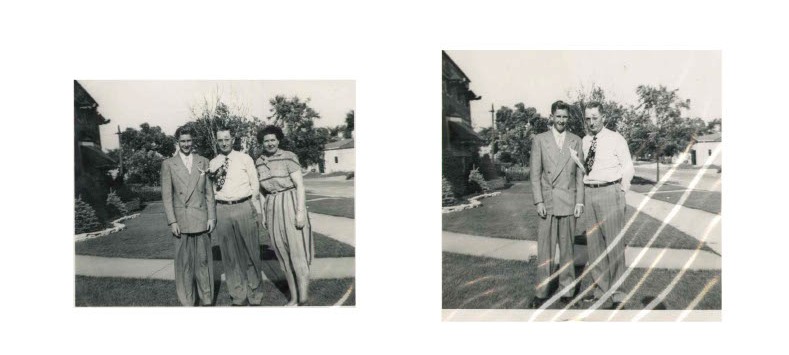
Statement by Richard Allen Hilton
A RESUME OF MY PAST EMPLOYMENT HISTORY
1945 ++
At about the age of nine I started working. My very Iirst job was delivering papers for the Mont Clare Herald, a weekly publication put out by the Pioneer Press. My delivery route was Oak Park Ave., Newcastle Ave., New England Ave., Newland Ave., and Sayre Ave. from Dickens Ave south to North Ave. Delivery was on foot, pulling my wagon load of papers and hand delivering to the front porches or tucking the paper into entry or storm door handle & knob.
I only delivered to subscribers. The subscribers received and paid bills by mail. If they stopped subscribing, Pioneer Press advised me to stop delivery. Sometimes I would knock on doors and talk to people to make sure they really didn’t want the newspaper delivered, as it was the only source for\ neighborhood news. Sometimes they would renew their subscriptions. My most success in accomplishing renewals was with the elderly women who lived along my route. They used to watch for me and offer an occasional cookie.
While working this job I met many nice customers but four stand out, two by name, one by profession and one by deed.
Sam Giancana was a local notorious “gangster” who lived on the 1600 block of New England Ave. for a time. During my first year as a “paper boy” he moved out of Chicago to the neighboring suburb of River Forest. I never talked to him or had anything to do with him for obvious reasons. Many years later he was murdered while playing cards in the basement of his River Forest home. http://spartacus-educational.com/ JFKgiancana.htm
Mr. & Mrs. Sayre lived on the 2000 block of Sayre Ave., a couple of houses south of where Kim Novak grew up (see below). Harriet E. Sayre School and Sayre Park were named after members of their family who were early settlers in the area. Mr. & Mrs. Sayre were an older couple and their home was heated with a coal Iired furnace. The furnace was in their basement and one day while delivering papers Mr. Sayre asked me if I could help him remove the coal cinders from his furnace. This turned into a regular Saturday morning job during the winter months. For a couple of dollars I would go into their basement and put the cinders into a metal bucket, carry them out and dump them into the cinder alley that ran between the back side of the houses on Newland and Sayre avenues. That alley and most if not all in the neighborhood are now paved with concrete.
Kim Novak grew up on the 2000 block of Sayre Ave. Her real Iirst name was Marilyn. I did not know her, as she was 3 years older than me. She became a famous movie star when I was in my middle teen years, something that I wished I had known sooner as I was later told that she used to sun bathe in her back yard. Hubba hubba!.
An elderly woman whose name escapes me lived near the end of my route in the 2000 block of Newland Ave. On one extremely cold, snowy day as I was delivering the last of my papers and feeling very cold, she met me at the door and invited me inside to warm up. Their house was heated by steam circulating through radiators. She let me stand next to the radiator in their living room and gave me some cookies and hot chocolate. I can remember that we had a nice chat. Meanwhile, your Grandmother Hilton became concerned and worried that something might have happened to me because I was still out “delivering papers” past the time when I should have gotten home. She bundled herself up and went out looking for me and located my wagon but I was nowhere to be found. Fortunately I spotted her, got my coat and 4 buckle goulashes on, thanked the lady for the heat and the hot chocolate and ran out to catch up with mother. Needless to say, we had a one-way conversation all the way home!
Summer, 1949(?)
After obtaining my bike and learning to ride I began working for the Chicago Herald American, a daily subscription newspaper published for release in the afternoon. I would ride my bike to a garage (work center) located behind a house just off the northwest corner of Grand Ave. and Oak Park Ave. The papers would be bundled for my route. They needed to be folded individually for throwing onto the porch of the subscriber’s houses while riding past on my bike. The papers would be loaded into a bag that would be hooked to my handlebars so that I could grab and throw with one hand while steering with the other. Unfortunately I did not always hit the porch and some would end up in the bushes. Not good as I also had to collect the weekly subscription fee which enabled customers to sometimes have a few less than kind words for me when I called on them. I sometimes would mention that as a left handed thrower, I wasn’t always able to hit the porch. My sandlot baseball buddies also recognized this problem and I would end up spending a lot of time playing Iirst base or right field.
My route was almost a duplicate of my previous Mont Clare Herald route. Though I did not have this job for long I was able to receive two dresser lamps as a premium for signing up several new subscribers. I gave the lamps to my sister for Christmas that year.
1952
My first real part-time job was with Spra Con Corporation on Addison St. & Elston Ave. in Chicago. The company is no longer in business. I was starting my junior year in high school at Lane Tech. I worked in the drafting department and was responsible for operating the blue print machine and fifting blueprints of scaffolding plans produced by the department. I only worked there a short time as the job required that I work every afternoon from 3 to 5 and I would not get home from school/work until after 6:00 PM at night. This was right after Dad died and once mother found the job at Blue Cross Blue Shield I no longer needed to have a job as in mom’s mind, school was more important.
During the rest of my high school years I worked several part time jobs. One summer I worked part-time at Wilson Sporting Goods Company, lacing up leather baseball mitts. This job is also where I learned to smoke cigarettes, sitting on the Iire escape, smoking and lacing up gloves. As best I can recall, the job did not pay well and lasted only through the summer months.
This job was followed by a part time Saturday job at a gas station on Diversey Avenue in Elmwood Park. My brother-in-law, your Uncle Bill Marsells purchased gas at this “full service gas station” when he and my sister (your Aunt Alma) lived in the basement of his parent’s house after they were Iirst married.
I was a gas pump attendant. People would come in to buy gas by pulling up next to the pump, remain in their car and wait for me to remove the cap and start the gas pump. I would then wash their windshield and wait for them to pop the engine hood so that I could check the oil. After wiping the oil dip stick with my rag I would put the dip stick back into its holder and again remove it . The technique I was taught involved holding the dip stick by its handle and placing my rag under the tip of the stick in order to catch any dripping oil. I would then hold the stick up so that the driver would know that I checked it and could see the oil level. If the oil level was low I would remove the cap from the oil filler tube. Then I would take a metal oil can over to the drum of oil located inside the building in the area known as the grease pit, and turn the hand crank to pump oil into the can. The filler tube or nozzle of the can was hinged so that by holding my finger over the end of the tube I could swing it down and the oil would flow into the filler tube. After replacing the cap I would again check the oil to make sure it was at the right level. I would then take the money from the driver and immediately report to the owner who would give me change from the wad of bills he kept in his pocket that I then took back to the driver . This job and the owner made me feel very important.
After working at the gas station for a while I was able to get a part time job working Saturdays at a men’s hat store located in the area that is now the Harlem Irving Shopping Plaza located at Harlem Avenue and Irving Park Road. The store was located in what then was a small strip mall. It was a true haberdashery with a full assortment of felt hats of various sizes and shapes. In looking back on this job I think that this is where I learned to appreciate and enjoy various styles of men’s hats. This job was truly fun however the owner did not always see the humor in my approach to modeling hats while at work.
My next Saturday job was at Maurice L. Rothschild’s Department Store, (in the building that is now the John Marshal Law School) a department store located on State Street at Jackson and just north of Van Buren Street in the Chicago Loop. The building was a multi-story men’s and women’s high-end clothing store. I worked in the fur storage section, taking in and delivering fur coats that were brought into the store for cleaning and cold storage during the summer months. What I remember most about this job is that going to and from work I had to pass by Minsky’s Burlesque Theatre located on the corner of Van Buren and State Streets. There was always a lot of music and noise. They even had a “hawker” in front of their entrance door trying to get people to come in to see the show. I never was able to get in to see the show as Minsky’s was closed down by the time I was old enough to gain entrance. A distinct disadvantage to being young I guess and NO, I did not meet your Mother there!.
After high school and while attending my 1st year of college at Elmhurst I was able to find a part-time job at Wiebolt’s Department Store at Lake & Harlem Avenues in River Forest. Of all possible departments, they assigned me to the women’s lingerie department. Wahoo! The only people working in this department were women and they needed a big, strong “man” to handle the stock. Keeping the bras girdles & panties stocked and sorted by size was a blast. However, through all the time that I worked there they never did allow me to wait on any customers. I worked there until I went into the U.S. Army in 1955.
I hope that you enjoyed reading a bit about my early work history. I wish I could remember more about the happenings but too much time has gone by and my memory ain’t what it used to be. It was a varied and enjoyable time that has gone by all too quickly.